Seven Things to Pin Down Before the Summer Fete (From the People Who Take the Booking Call)
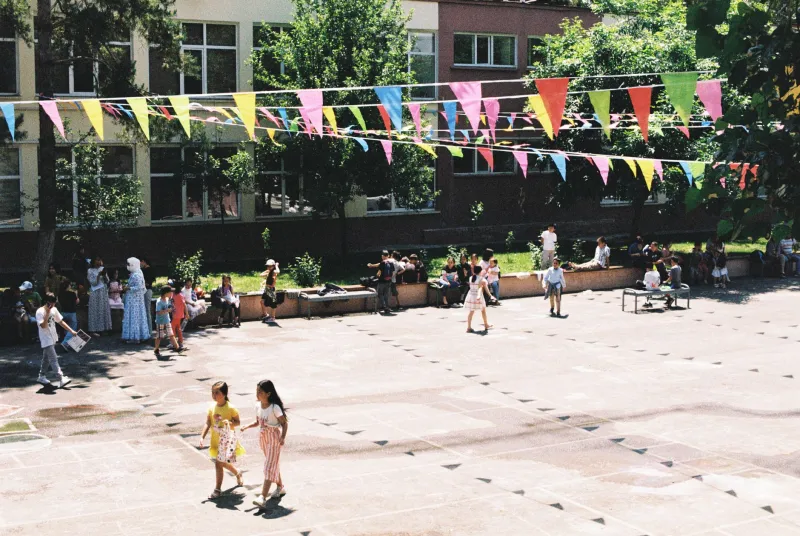
We take a lot of booking calls between February and May, and by now we can hear a PTA organiser from the opening sentence. There's a particular tone — warm, apologetic, faintly terrified — that says: this was my idea, the committee agreed it in September, and I have only just realised what I've signed up for.
Good news: it's all manageable. Better news: most of the classic summer fete problems are avoidable if you nail seven things early. In roughly the order we'd ask them.
1. What's the Actual Floor Space — Including Door Swings?
Not the field. The field is fine and generous and everyone's field is fine. We're asking about the twenty square metres you actually want us in, and specifically whether anyone has measured it since the caretaker's storage container arrived.
When you measure, measure the full sweep: where doors open, where the burger van needs to sit, where the queue for the tombola will inevitably sprawl. A play area with a queue running through it is a play area with a fire exit blocked, and that stops being a fete problem and starts being a problem.
Send us a photo and a rough sketch. No one has ever regretted sending a photo. Plenty of people have regretted not sending one.
2. Where's the Power, and Who Owns It?
Some of our kit is quiet and people-powered. Some of it — blowers, lighting, the low-hum stuff — needs a socket or a generator.
Three things to sort out: is there a socket within reach of a safe cable run (not a heroic cable run), who is providing the extension leads, and whose job is it if a fuse goes? If the answer to the last one is "the caretaker, probably," find out the caretaker's phone number and check they're in.
We'd also gently ask you to consider putting the noisy powered stuff further from the quieter stalls. The plant stall does not need a blower in its ear for six hours.
3. Whose Insurance Covers What?
This is the one that makes people go quiet on the phone.
You want to know two things before we arrive: that we hold our own public liability cover and that the venue's insurance permits a play activity of this kind. Nine times out of ten both are already fine. The tenth time is why we ask in March rather than the Wednesday before.
Ask us for our certificate. Ask us for a risk assessment and a method statement — we have standard versions and we will adapt them to your venue. Then send them to whoever handles the school's or the parish's cover, and get a yes in writing. It takes a fortnight at most and it is the single most boring hour you will spend on this fete.
4. What Ages Are Actually Coming?
"All ages" is what everyone says, and "all ages" is what causes the trouble.
We need to know roughly where the bulge is. A reception-and-Year-1 fete needs different kit to a whole-primary-plus-siblings fete, which needs different kit again to one that also has a toddler-and-bumps corner and a handful of Year 9 volunteers who will absolutely want a go.
Be honest about the attendance pattern, too. Most school fetes have a 2pm crush and a 4pm drift. We'd rather design for the crush and accept that the last hour is a bit roomy than build something that's only full at half two and looks sad by four.
5. What Happens If It Rains Sideways?
We have a whole separate article on this, but the short version: decide now, not at 8am on the day.
Agree three things in advance:
- A go/no-go time. Ours is usually 7:30am, and we will tell you either way.
- A wet-weather alternative. A hall, a covered walkway, a marquee with two open sides. If the plan is "we'll see," the plan does not exist.
- A postponement clause. Written down, both sides happy with it, so nobody is having an awkward conversation while holding a soggy clipboard.
Light drizzle is usually fine. Wind is not — anything inflatable goes away at the first meaningful gust, and we will be the ones saying so, loudly, whatever you've advertised.
6. Can Everyone Actually Get In?
A hard mat is not the same as an accessible surface, and a ramp onto grass is not always a ramp for long.
Ask yourself: can a wheelchair, a mobility scooter or a double buggy get to the play area without going over a lip, a kerb or an unrolled cable? Is the quiet area on the same level? Is there a loo within a sensible distance?
We can supply flat matting and low thresholds, but we can't flatten your site. Telling us early means we can plan the layout around the routes that already work rather than apologising for the one that doesn't.
7. What's the Budget — the Real One, Not the Nice One?
Have the awkward conversation with your committee before you talk to us. Not "what would we like to spend" but "what have we actually got, including the bit set aside for the thing that always breaks."
Be clear about what's included: set-up time, pack-down time, staffing for the session, whether you want us to run the play or just supply the kit, and whether travel is extra. A quote that doesn't mention set-up isn't a cheaper quote; it's an incomplete one.
And do ask about the middle option. Most PTAs come to us wanting either a giant showpiece or the smallest thing we do, when the sensible answer is usually halfway: one good focal piece, a couple of quieter zones, staffed properly. It photographs well, it spreads the crowd, and it costs less than the blow-up castle everybody keeps mentioning.
The Question We Wish You'd Ask First
"How long do you need?"
Because that's the one that quietly sets the whole day. A play build needs real time on site — usually two hours before, an hour and a half after — and if your fete opens at eleven and the field isn't available till half nine, something has to give, and it's never the burger van's parking.
Ask it in the first email. We'll tell you the truth, including when the answer is "not enough, but here's how we'd work around it." That's a much better conversation to have in February than in the car park at nine o'clock on a Saturday morning in July.