Dim Lights, Clear Exits: What a Library Taught Us About the Quiet Hour
We have built play sessions inside barns, on high streets and once, memorably, in a courtyard with a goose in it. None of them taught us as much, as quickly, as the quiet hour we ran in a library.
It was not a disaster. It was something more useful than a disaster — it was a near-miss, the sort you replay for months afterwards, picking at the seams.
The Quiet Hour Is Not Just a Turned-Down Speaker
The first mistake people make with sensory-friendly sessions is thinking they are a volume knob. Turn the music down, dim a light, job done, put the kettle on.
It isn't. A quiet hour is a different kind of room, and a different kind of promise. Families who come to these sessions have usually been burned before — by a soft play centre where the hand dryer nearly caused a meltdown, by a fete where a generator droned for four hours, by a party where somebody's uncle thought a whistle was a good idea.
So the promise we make is not "it's quieter here." It is "nothing unpredictable will happen to you in this room." Every design decision gets measured against that sentence.
Lighting Is the Thing Nobody Mentions
Ask a parent what ruined a session and they will rarely say "the lighting." But ask a SENCO and lighting often comes up inside the first three minutes.
Fluorescent strips are the enemy. Not because of the light itself, mostly, but because of the barely-audible hum and the flicker that some children register long before any adult does. We now carry diffusion fabric and a couple of clip-on LED panels, and we ask venues one blunt question before booking: can we turn the main lights off entirely and still see well enough to spot a dropped shoe?
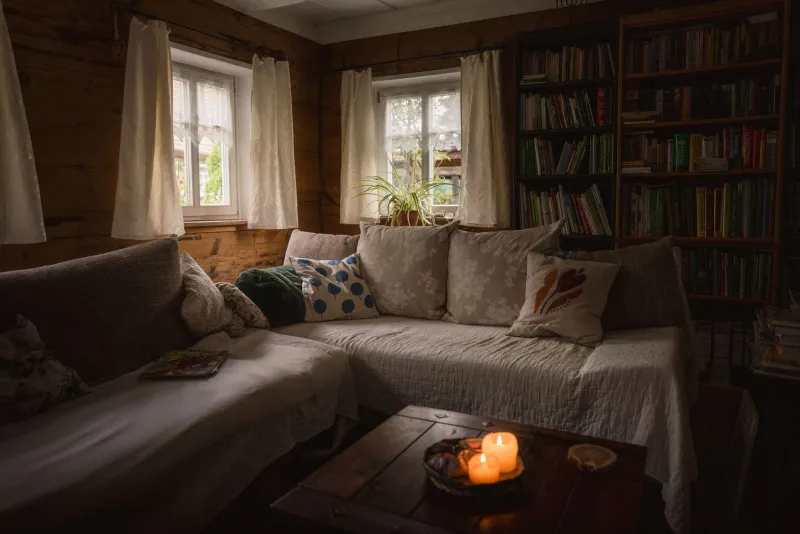
Where we cannot, we work in pools of light instead — a low lamp over the drawing table, a lantern corner, a soft glow over the reading rug. Contrast matters more than brightness. A room that is dim but even reads as calm. A room with one blazing strip and depthless shadow reads as a threat.
Sound Is Not Only Volume
We ran a sound check in that library with a decibel meter and everything came back beautifully on target. Then a child arrived and immediately went and stood by a chair, because of the way the chair legs scraped on that particular floor.
Two lessons, both obvious in hindsight. First, suddenness is worse than loudness. Second, the sounds that get people are rarely the ones you measured.
We now carry felt pads by the dozen, we tape down cable runs even when they are a metre away from where anyone will walk, and we test the room with children's shoes on rather than our own. The library session also got us into the habit of an unofficial "door audit" — a slow walk round the space making the sort of noises a six-year-old makes, listening for what answers back.
Exit Routes Are Design, Not Fire Regulations
Here is the bit we got wrong.
In the library we had laid the space out beautifully: soft mats, a book nook, a small construction zone. And we had, without really thinking about it, made a cosy corridor of it. Fine for most children. Less fine for a child who needs to get out, right now, and will take the shortest line to do so — even if that line goes past the token table.
The child was fine. A staff member spotted the movement early, the child stopped at the door, and the moment passed before it became anything. But we changed the layout the following week and we have not gone back.
Our rule now: every session space must have one clear, visible, unobstructed exit route that a child can reach without passing a table, a queue or a stranger, and a second route that staff can use without funnelling everyone through the same gap. Door staff do not stand in doorways. They stand beside them, angled, and they do not chat.
The Quiet Zone Needs a Job and a Person
We used to set up a "calm corner" and watch it fail. It failed because it was a corner with some cushions in it and no reason to exist, and children will not go to a place that looks like a punishment.
What works, in our experience, is giving the quiet zone a job. A shelf of books. A single puzzle. A light table. Something a child can be doing rather than something they are being sent to.
And it needs a person. Not a bouncer — a host. We now staff it, and we brief that person to never ask a child why they are there. They offer. They do not interrogate.
Staff Training, in Plain Terms
We run the same briefing for every sensory-friendly session regardless of venue:
- Lower your voice, don't whisper. Whispering is a noise people lean in to hear, and leaning in is not calm.
- One question at a time. "Do you want to draw, or shall we look at the book?" beats "what do you want to do?" every single time.
- Never block a doorway, never stand over a child, never touch a child without an obvious reason and an audible warning. "I'm going to move this mat, is that alright?"
- Know your three answers. Where the quiet zone is, where the loo is, and how to get out. Anyone in a branded shirt should be able to answer all three without breaking stride.
- Let people leave. No chasing, no coaxing, no "you've only just got here." The whole point is that the exit is easy.
We also ask venues to switch off, physically, whatever they can: hand dryers, lobby screens, that one tannoy that goes off at half past. It is astonishing how often the loudest thing in the building belongs to the building.
What the Hour Is Actually For
Here is the honest bit. Sessions like this rarely produce the photographs. There is no confetti cannon moment. What you get instead are children staying ten minutes longer than last time, a parent sitting down for a coffee for the first time in an hour, and a SENCO asking if you'll come back in the spring.
We have started booking these sessions in pairs rather than singly, because the first one is reconnaissance and the second one is the actual event. That's not a sales line, it's a design note. You cannot understand a room's sound and light until you have watched a child move through it.
If you are a venue wondering whether your space could hold one, our advice is to try a small version first — twenty children, a couple of hours, one quiet zone, one clear exit, and staff who are allowed to say no to well-meaning interuptions. It is the cheapest thing we do. It is also the one we prepare hardest for.