The Cardboard Box Beat the Ball Pool: What 100 Leaving Children Told Us About the Best Bit
Photo: Copy of Boethos of Chalcedon, Public domain, via Wikimedia Commons
There's a moment at the end of every Pop Up & Play Co. session that we usually spend packing away. This season, we spent it asking questions instead.
Armed with a clipboard, a tub of biscuits and a healthy amount of guilt about delaying tea time, we spoke to one hundred children as they left our pop-up sessions across five locations — a shopping centre in Leeds, a library in Norwich, a village hall in the Cotswolds, a converted warehouse in Salford, and one very draughty community centre in Fife. One question, asked the same way every time: what was the best bit?
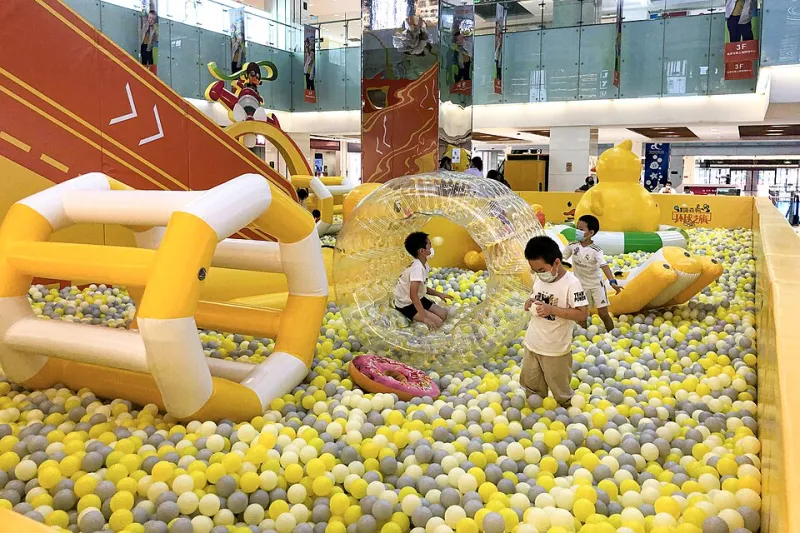
We expected to hear about the ball pool. We'd built the ball pool. The ball pool had its own risk assessment, its own dedicated build day, and its own line in the booking confirmation. The ball pool, we assumed, was the reason people came.
We were roughly half right. And the half we got wrong is the most useful research we've ever done.
The Leaderboard Nobody Budgeted For
Let's start with the numbers. Out of a hundred responses, the headline attractions — the ball pool, the climbing frame, the interactive projection wall — accounted for thirty-eight mentions. Solid, but hardly a landslide for the things that ate most of our build budget.
The remaining sixty-two answers were, frankly, all over the shop. And wonderful. Here's the top five of the unsanctioned favourites:
- The cardboard boxes the equipment arrived in — nineteen mentions. Children sat in them, wore them, pushed each other around in them, and in one memorable case in Salford, held a funeral for one.
- The ramp — eleven mentions. Not a feature. A compliance requirement for wheelchair access that children discovered was brilliant for running up and down and launching toy cars.
- The door curtain — nine mentions. A heavy strip curtain separating the play zone from reception. Children ran through it repeatedly, making it billow. Nine separate children described this as their favourite thing, unprompted.
- A member of staff called Dev — seven mentions. Dev can juggle. Dev was not hired to juggle. Dev is now contractually expected to juggle.
- The step at the entrance — six mentions. Children jumped off it. Repeatedly. For entire sessions.
Add it up and the infrastructure — the boxes, the ramp, the curtain, the step — outperformed everything we'd actually designed, combined.
So What Went Right?
It's tempting to read this as an argument against design, and we've heard that take already from a well-meaning brand manager who shall remain nameless. It isn't. It's an argument about what children are actually looking for when they play.
The ball pool is a destination. Children enjoy it, but they don't do anything with it — you get in, you float about, you get out. The cardboard box, the ramp, the curtain: these are tools. They have physics. They respond. A box can be a boat, a rocket, a hat, a coffin for an imaginary hamster. A curtain is a wall that breaks. A step is a cliff. Children aren't rejecting our designs — they're telling us, loudly and for free, that they gravitate towards materials with possibilities.
There's a lovely old bit of play theory about this — the loose parts idea, the notion that a crate of planks outperforms a fixed climbing frame. We knew it. We'd read it. We'd still spent a fortnight powder-coating a frame that finished sixth on its own exit poll.
What We've Changed Since
This wasn't a purely academic exercise, so here's what's actually different about our builds this year:
We build in the props, not just the play. Every session now ships with a deliberate pile of open-ended material — boxes, tubes, fabric, crates — positioned where children will find it themselves. Found treasure beats provided treasure, every time.
We've stopped hiding the mechanics. The ramp gets a rail to slide down. The step gets a proper landing zone. The curtain stays exactly as heavy and billowy as it is. If children are going to love the infrastructure, the infrastructure might as well be safe and intentional.
We budget for a Dev. Two hours of a genuinely playful member of staff — someone who'll juggle, referee a box race, remember a child's name — outperformed several hundred pounds of kit in our poll. It's the cheapest line in the quote and increasingly the one we defend hardest.
The Uncomfortable Bit for Designers
Here's the honest conclusion, and it stings a little to write. Some of the most elaborate things we've ever built have been, from a child's perspective, scenery. Expensive, well-engineered, beautifully branded scenery that they walk past on the way to the box.
That doesn't mean the craft doesn't matter. It means the craft should be spent where the possibilities are. A beautifully finished surface that children can slide down, hide behind, or prop something against will always earn its keep. A beautifully finished surface that only does one thing is a very expensive wall.
We'll keep asking the question at the door, biscuits and all. Because the hundredth child told us the best bit was "going home to tell my mum", which is either the sweetest answer we've ever recorded or a gentle reminder that the best play experience is the one that gives you something to talk about on the walk back to the car.
Both, probably. Both works too.