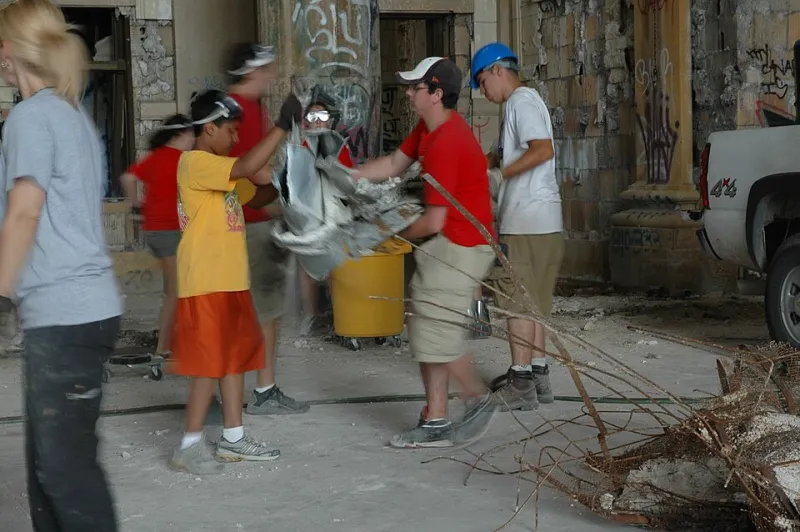
The Dismantler, The Runner and The Button: Casting the Child Who Breaks Your Pop-Up (On Purpose)
Photo: Orgio89, CC0, via Wikimedia Commons
There's a moment in every pop-up we build when a child walks in, scans the room, and ignores everything we spent six weeks making. They don't head for the slide. They don't queue for the sensory tent. They make a beeline for the fire door, the cable trunking, or — in one memorable case in Loughborough — a light switch that was never meant to be part of the experience.
We've come to love these children. Genuinely. We call them the stress-testers, and after dozens of activations from Carlisle to Cornwall, we've learned to spot them within the first ten seconds of doors opening.
The Ten-Second Rule
Here's how it works: within ten seconds of a session starting, one child will do something the risk assessment never predicted. We watch for it. We write it down. And more often than not, that single act of chaos teaches us more about the build than the previous fifty polite sessions combined.
A focus group will tell you what parents think children want. A ten-second window tells you what children actually do when confronted with your design choices — unfiltered, unmoderated and usually at speed.
Meet the Cast
Over the years we've informally catalogued a few recurring characters:
The Dismantler. This child doesn't play with the installation; they disassemble it. Velcro tabs? Off. Modular foam blocks? Reconfigured into something structurally inadvisable. The Dismantler is our best structural engineer, because they find the one joint we under-spec'd in record time. If a panel survives a Dismantler, it survives anything.
The Runner. The Runner bypasses the entrance flow entirely and does a lap of the perimeter before anyone can intervene. They map the space in seconds. If there's a blind corner, a trip hazard or an unsupervised gap between zones, the Runner will find it before our floor staff have finished their safety briefing. We now design our sightlines for the Runner.
The Button. Some children are drawn to anything that looks like it controls something. A big red dome switch on our ball-pool air blower in Sheffield was pressed 400-odd times in a single day — mostly by children too small to reach it without a chair. It never broke, because we'd learned our lesson the year before in Dudley. It's the Button who teaches you about build quality.
The Escape Artist. And then there's the child who heads for the exit. Not because they're unhappy — often they come back within a minute, glowing with the triumph of having tested the boundary. But their instinct to probe the edges of a space is exactly the instinct we need to design for. Exits, thresholds and transitions are where most meltdowns and near-misses happen, and the Escape Artist shows us where the friction points are.
Why Brands Should Care
If you're commissioning a family activation — a shopping centre takeover, a festival crèche, a supermarket car park event — you're not really buying a play area. You're buying a system, and systems need testing under real conditions.
The polite child who follows the intended journey proves your design works. The child who doesn't proves your design holds. Both matter, but only one of them is going to appear in your planning meeting.
Our practical advice, learned the hard way:
- Budget for the Dismantler. Specify fixings for a child with a screwdriver's determination and no screwdriver.
- Walk the space like the Runner. Before doors open, do a perimeter lap at toddler speed and see what you notice.
- Assume every button will be pressed. Repeatedly. By someone standing on something they shouldn't be standing on.
- Treat the exit as a feature, not a failure. Good sightlines, a clear threshold and a friendly face by the door solve most of what the Escape Artist exposes.
The Bit We Can't Measure
There's a temptation, especially with brand stakeholders in the room, to want clean data: dwell time, footfall, engagement scores. We collect all of it. But the number we trust most is scribbled on a clipboard by the door — the ten-second note about what the first child did that we didn't expect.
In Leeds last spring, that note read: "kid took the cone. kept the cone all session. named it." We've since added a prop cone to two builds. It's not in the risk assessment. It's not in the client deck. It's just the sort of small, weird, wonderful thing you only learn when you stop designing for the average child and start paying attention to the one who heads for the fire door.
They're not breaking the experience. They're finishing it.