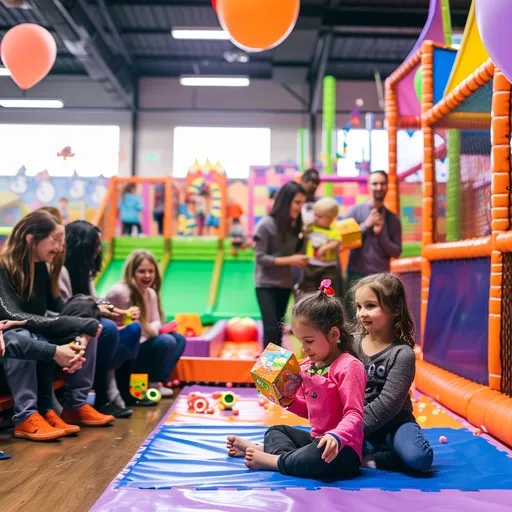
Balloons, Bric-a-Brac and a Budget of Fifty Quid: Our Honest Guide to Play on the Cheap

Photo: Basile Morin, CC BY-SA 4.0, via Wikimedia Commons
There's a myth that hangs over the play industry like glitter that never quite sweeps up: the idea that memorable play experiences require serious money. Marquees. Bespoke fabrication. A van full of kit and a crew of six. We'd be lying if we said we don't love a big build — but some of the work we're proudest of cost less than a family shop at Aldi.
So we've gone back through our job sheets and pulled out the receipts. Here's what fifty quid actually buys you in the world of pop-up play, what we reach for time and again, and the materials that have burned us more than once.
The Anatomy of a £50 Build
Our most-requested low-budget setup is what we internally call the Trestle Special: a play zone cobbled together for a community fete, a small shop's half-term event, or a library open day. The last one we built — a 'sensory corner' for a garden centre in Loughborough — came in at £47.30. Here's the rough breakdown:
- Balloons (a lot of them): £8. Cheap, cheerful, endlessly reusable as the basis for games. A balloon keepy-uppy zone with a piece of string as a net has occupied children for hours.
- Chalk: £4. Pavement chalk turns any hardstanding into a hopscotch course, a racetrack, a town. It washes away, which landlords love.
- Foam sheets and tape: £11. Cut into shapes, they become building blocks, targets, costume pieces.
- A ball pit made from a paddling pool: £14, plus whatever offcuts and leftover stock the client chucks in.
- Printed signage: free-ish, because we design it in-house and the client prints it.
The rest went on gaffer tape, which — rule one of pop-up anything — you can never have too much of.
The Materials We Trust With Our Lives
Every play designer has a toolkit they'd grab in a fire. Ours looks like this:
Cardboard tubes. Free from carpet shops and fabric wholesalers, who are usually delighted to be rid of them. They become telescopes, marble runs, periscopes, wacky-style sound pipes. In our experience a wall of tubes will hold a child's attention longer than most £200 plastic contraptions.
Balloons, again. They're the workhorse of cheap play. They're also the only decoration that doubles as an activity — blow up fifty, scatter them, and you've got a game before you've even explained the rules.
Masking tape on floors. A taped-out grid becomes a noughts-and-crosses board, a maze, a 'lava floor' challenge. It peels cleanly off most surfaces, which matters when you're borrowing a shopfloor on a Saturday.
Leftover stock. This is the one small brands sleep on. A stationery shop we worked with in Sheffield let us build a play zone entirely from their overstock — paper plane testing stations, a 'design your own bookmark' table, a rubber-band shooting range into a cardboard castle. Zero material cost, and the shop shifted a surprising amount of stock the same weekend because children dragged their parents straight to the shelves.
The Ones That Always End in Tears
We'd be doing you a disservice if we only shared the wins. Learn from our scar tissue.
Glitter. Never. Not at any price. We still find it in kit bags from 2022.
Cheap face paints. The £3 festival sets from the supermarket are watery, streaky and cause more tears (children's and parents') than any other single purchase we've made. If you're doing faces, either do it properly or don't do it at all.
Unweighted balloons outdoors. One gust of wind across a market square in Doncaster and we spent twenty minutes apologising to a very confused dog.
'Waterproof' cardboard. It isn't. It never has been. The laminate spray helps for about an hour and then deludes nobody.
Borrowed furniture without checking it. A trestle table with one dodgy leg has ended exactly one of our builds, mid-session, with a crash that silenced the whole fete. Inspect everything.
What Cheap Play Actually Teaches You
Here's the thing nobody tells you about working on a shoestring: it makes you a better designer. When you can't rely on fabrication or a big install, you have to design the idea of the play, not the props. A well-briefed game with good rules and a clear hook will outperform an expensive prop with no purpose, every single time.
So if you're a small brand, a market stallholder, a community group with a grant of a few hundred quid — don't wait until you can afford 'proper' play design. Fifty pounds, a roll of tape and a bit of imagination will get you further than you think.
And if you need a hand, that's rather our speciality. Bring your budget — however modest — and we'll bring the balloons.