Built at Crawl Height: Why We Design Every Pop-Up Starting From the Floor Up
Photo: MIKI Yoshihito, CC BY 2.0, via Wikimedia Commons
There's a moment on every family-facing pop-up install that we've come to dread. It's about an hour before doors open, when the client wanders in, looks around at the beautiful, Instagram-ready set we've spent six weeks building, and asks: "But what do the little ones do?"
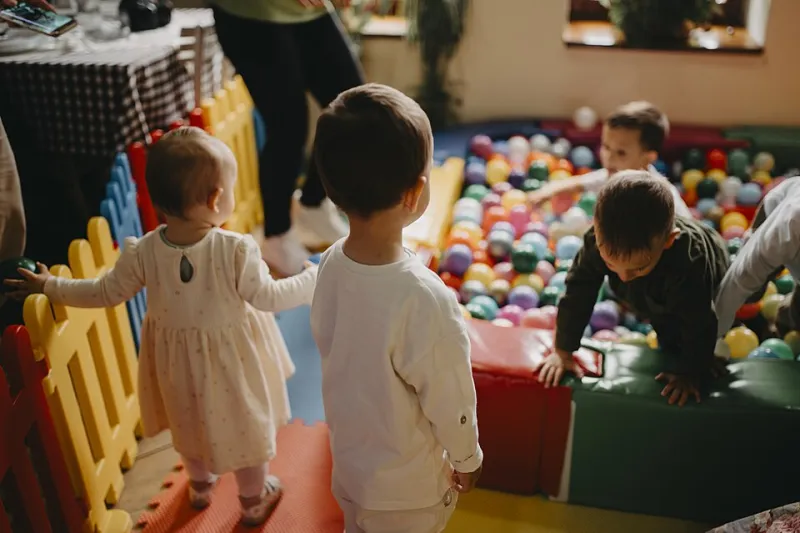
The little ones. The under-fives. The very audience half of these activations are supposedly for — and the group most likely to be treated as an afterthought, bolted on with a token soft-play corner and a box of crayons.
We know because we used to be guilty of it ourselves. This is the story of how the smallest visitors in the room rewired our entire design process.
The two-metre rule
It started as a joke on the workshop wall. Our senior designer, Priya, pinned a note above her desk that read: "If you've only looked at the build standing up, you haven't looked at it."
The idea stuck, and it became policy: before any family experience is signed off, the whole design team gets down — genuinely down, on hands and knees — and experiences the space at roughly two feet high. Hence the two-metre rule, measured in the only unit that matters: how far can a toddler reach?
It's amazing what you notice from down there. Signage positioned for adult eye contact is invisible. A low shelf that looks like display storage to a grown-up looks like a climbing frame to a three-year-old (and will be used as one, within minutes, guaranteed). Gaps between modules that a parent would never notice are exactly the width of a small head, which is a problem under any risk assessment.
The checklist we now won't build without
Every under-fives project runs through the same pre-build interrogation. Some of it is common sense once said out loud; all of it was learned the hard way.
Choke-test everything. Any component that can detach must pass the standard small-parts cylinder test. That gorgeous hand-painted wooden toadstool with the little door that opens? The door knob failed the test. It's now a fixed disc. Nobody has ever noticed but us.
Crawl heights and reach zones. Interactive elements live between 400mm and 900mm off the floor. Anything higher needs a reason, and "it looked better in the render" isn't one.
Materials that survive mouths. Under-fives taste-test everything — it's not a design flaw on their part, it's their primary research method. So: no toxic finishes, no loose fibres, no materials that splinter or flake. We've moved almost entirely to FSC-certified ply with a food-safe sealant on anything touchable.
Soft landings, everywhere. Not just under the climbing bits. Under the walking bits. Under the standing-still-looking-at-a-wall bits. Trips, not falls from height, are the real statistic.
Escape-proof, parent-friendly sightlines. Enclosed play feels safe; enclosed play with no visibility gives parents genuine anxiety. Low barriers, clear lines of sight, and exits that a two-year-old can't defeat but a panicking adult can open in one second.
Nap-proof scheduling
Here's something no design software will tell you: the best-built under-fives experience in Britain will fail if your session slots run straight through nap time.
We learned this at a shopping centre activation in Leeds where our 1pm–3pm slot was, in retrospect, a monument to optimism. Under-fours across West Yorkshire were unconscious. Footfall was fine; actual play was nonexistent. We now build timetables around the sacred rhythms of the British toddler: morning sessions for the energised, a post-lunch lull nobody should try to fight, and a late-afternoon window for the post-nap crowd.
Timed slots help here too — not just for crowd control, but because an hour is roughly the maximum before small batteries die completely. Cap it, clean it, reset it, go again.
The compromises nobody photographs
Designing for under-fives means accepting trade-offs. Photogenic, delicate sets and snot-covered hands do not coexist peacefully. Everything we build now gets what we call the "wet wipe test": can it be cleaned by a member of staff with a baby wipe and thirty seconds, repeatedly, all day?
That rules out a lot. It rules out beautiful unsealed timber, intricate props with fiddly details, and anything with fabric covers that can't be removed and washed overnight. It also means our builds are chunkier and simpler than the ones on our mood board. That's fine. A play experience that looks stunning in photos but falls apart by Thursday afternoon isn't a success — it's a liability with good lighting.
The feedback that changed everything
The single most useful piece of parent feedback we've ever received came from a mum at a community pop-up in Sheffield. She said the space was lovely, but she'd spent the entire visit bent double, holding her child's hand, with a back like a question mark.
She wasn't asking for a better play area. She was asking for an adult-height place to sit inside the play zone — not at a café over the road, not behind a barrier, but in the thick of it, with a clear view and somewhere to park a buggy.
Now every family build includes parent seating within the play space itself, buggy parking that doesn't block fire exits, and — this one surprised us — hooks at adult height for the fourteen bags every parent in Britain is legally required to carry.
Because here's the thing we keep coming back to: if the grown-up is comfortable, the child plays longer. If the child plays longer, the activation works. Design for the smallest visitors, but never forget who's holding the car keys.