Conkers, Chalk and the Hopscotch Economy: What British Playgrounds Taught Us About Design
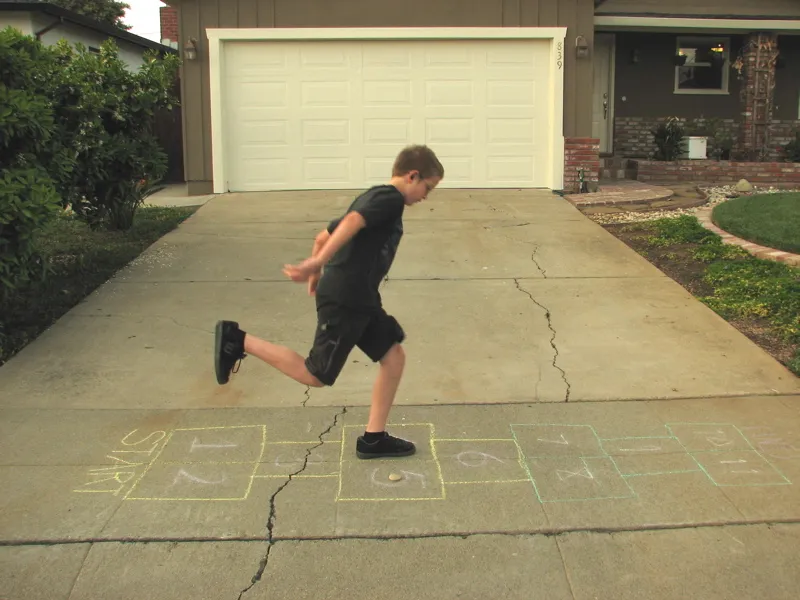
Photo: Lenore Edman, CC BY 2.0, via Wikimedia Commons
Every play designer worth their salt is a thief. Not of ideas from other designers — those are a dime a dozen — but of ideas from children themselves, because children have been running the most rigorous play R&D programme in the country for generations, unpaid, every lunchtime, in every schoolyard from Penzance to Peterhead.
We've been quietly raiding that archive for years. Here are seven things British playgrounds taught us, plus one glorious failure.
1. The Chalk Mural Wall
Give a child a piece of pavement chalk and a patch of tarmac and they'll build a world. We borrowed this wholesale for a family festival activation last summer: a long chalk wall where children added to a growing mural over the weekend. By Sunday teatime it had a lighthouse, a football pitch and what we're fairly sure was a drawing of the event manager's dog. Cost: pennies. Engagement: enormous. The lesson — the cheapest materials often produce the richest play.
2. The Conker Tournament
Every October, playgrounds across England become arenas of strict sporting regulation. String lengths are measured. Disputes are adjudicated. There is an ethics committee, apparently, and it is eight years old.
We ran a (safety-conscious, no-swinging) conker championship for a heritage brand's autumn activation and it was the busiest corner of the event. Adults got competitive. One gentleman in his sixties revealed he'd been county champion at school and had waited decades for a rematch. We believe him.
3. Hopscotch, But Make It a League
Hopscotch isn't a game; it's an institution with a rulebook that varies by postcode. We've leaned into that: at one shopping centre activation, we chalked out three different regional rule sets side by side and let families argue about which one was 'correct'. Footfall to the zone doubled. Nobody agreed on anything. Perfect.
4. The Wall Game
Stand near a playground wall and watch: children will invent a game with it within ninety seconds. Walls are for handball variations, for 'don't touch the floor', for shadow-chasing. Our design note from this: build one good vertical surface into every activation and the children will do the rest. We've watched a plain plywood wall sustain forty minutes of unbroken play without a single prop added.
5. The Trading Economy
Playground economies are ruthlessly sophisticated — pogs in the nineties, loom bands after, and before all of it, the great marbled tazos. Children love a currency. For a retail brand, we built a play zone where children earned wooden tokens through games and 'spent' them on small prizes. The queue management wrote itself, because the children policed it more firmly than any steward could.
6. The Quiet Corner
Not every playground game is loud. There's always the group sitting by the fence, trading secrets, playing something slow and observational. We now build a low-stimulation nook into every large activation — cushions, softer light, nothing beeping. Parents thank us for it more than they thank us for the ball pit, which tells you something.
7. The Invented Rule
The most magical playground games are the ones with rules only the players know. We've started leaving deliberate gaps in our instructions — a strange marked square with no sign, a button with no label — and letting children write the meaning themselves. The stories they invent are better than any copywriting we could commission.
The One We Left Behind: The British Bullied Bench
And now, the confession. We once built what we called a 'friendship bench' zone — a quiet seating area designed to encourage shy children to connect, inspired by a genuine playground initiative. On paper: lovely. In practice: children read it instantly as 'the naughty step' and avoided it like a wet playtime. One child asked their parent if they'd 'been put there for something'.
We retired it the same week. The lesson stuck: you can borrow the mechanics of playground play, but never the stigma. Children have an unerring radar for anything that feels like a lesson in disguise.
Playground culture is the most reliable play lab in Britain, and it's free to visit. We'll keep stealing from it as long as it keeps inventing — which, if the conker tournaments are anything to go by, is forever.